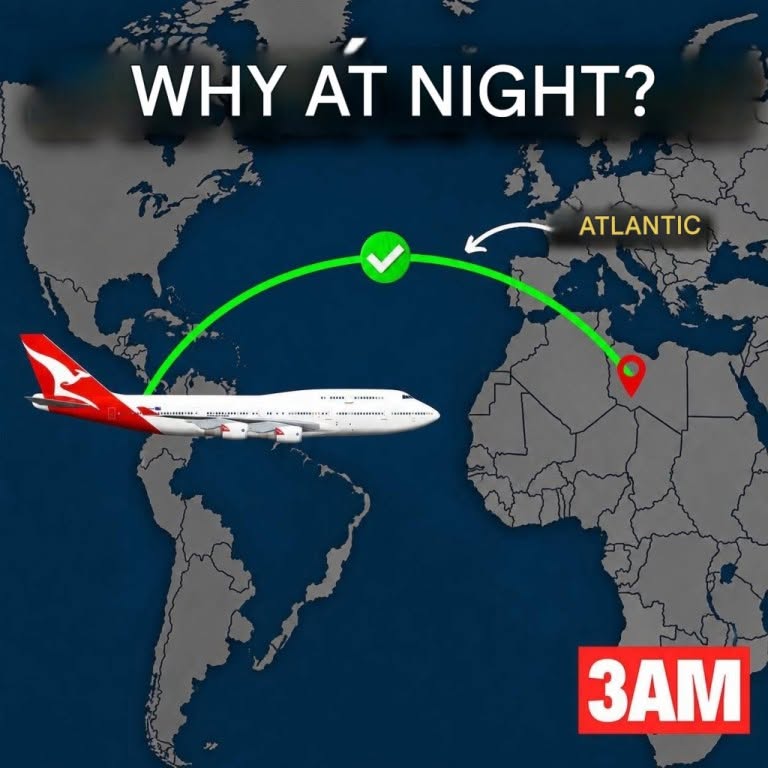
What About Daytime Flights From America to Europe?
They do exist.
Daytime transatlantic services operate on certain routes, including flights from airports such as Boston, New York, and Newark to London.
So the claim that planes never cross the Atlantic during the day is false.
It’s simply that overnight eastbound flights are much more common.
The scheduling pattern is so strong that it can make daytime eastbound flights seem unusual.
Airport Rules Matter Too
Airlines don’t schedule flights based solely on what’s happening in the sky.
Airports have their own limitations.
Landing slots, operating hours, noise restrictions, connecting-flight schedules, and passenger demand all influence when aircraft should arrive and depart. The FAA has specifically noted that passenger demand, time-zone differences, and airport noise restrictions help produce the familiar pattern of evening departures from North America and morning departures from Europe.
This means an airline is solving several problems simultaneously:
When should the passenger travel?
When should the aircraft arrive?
When are connecting flights available?
What are the winds doing?
Which route uses the least fuel?
What airport restrictions apply?
All of these factors come together to produce the schedule you see when you book a ticket.
There Is No “Daytime Danger” Over the Atlantic
One of the most common misconceptions is that airlines avoid daytime Atlantic crossings because flying over the ocean during daylight is somehow less safe.
That’s not the explanation.
Commercial aircraft routinely cross the Atlantic during daylight hours, and the overall pattern is primarily driven by scheduling and operational efficiency rather than a rule against daytime ocean crossings.
The North Atlantic airspace is used around the clock.
The Real Answer Is More Interesting Than the Myth
So, why don’t we see more planes crossing the Atlantic during the day from North America to Europe?
Because airlines have discovered that the overnight eastbound schedule works extremely well.
Passengers can sleep during much of the flight.
They arrive in Europe in the morning.
The aircraft can be used efficiently.
Connecting flights can be coordinated around arrival banks.
And flight planners can take advantage of favorable atmospheric conditions.
Meanwhile, the traffic flow reverses during the day, with large numbers of aircraft heading west toward North America.
So the next time you look at a transatlantic flight map and see aircraft seemingly moving in opposite directions at different times of day, remember:
There isn’t an invisible rule saying planes can’t cross the Atlantic in daylight.
There is an invisible system of time zones, jet streams, air-traffic routes, airport schedules, economics, and passenger preferences quietly determining when and where thousands of flights travel.
And once you understand that system, the flight schedule starts to make a lot more sense.